You might own the AI trade seven times — and call it diversification.
Star ratings rank funds on the last decade's returns. FundScore shows you the macro bets hiding inside the portfolio you already own — and how much value your managers actually added beyond just riding them.
One email when we open. No newsletter, no sharing your address.
No brokerage login required. No trading access.
One real portfolio
A five-star rating can't tell you this.
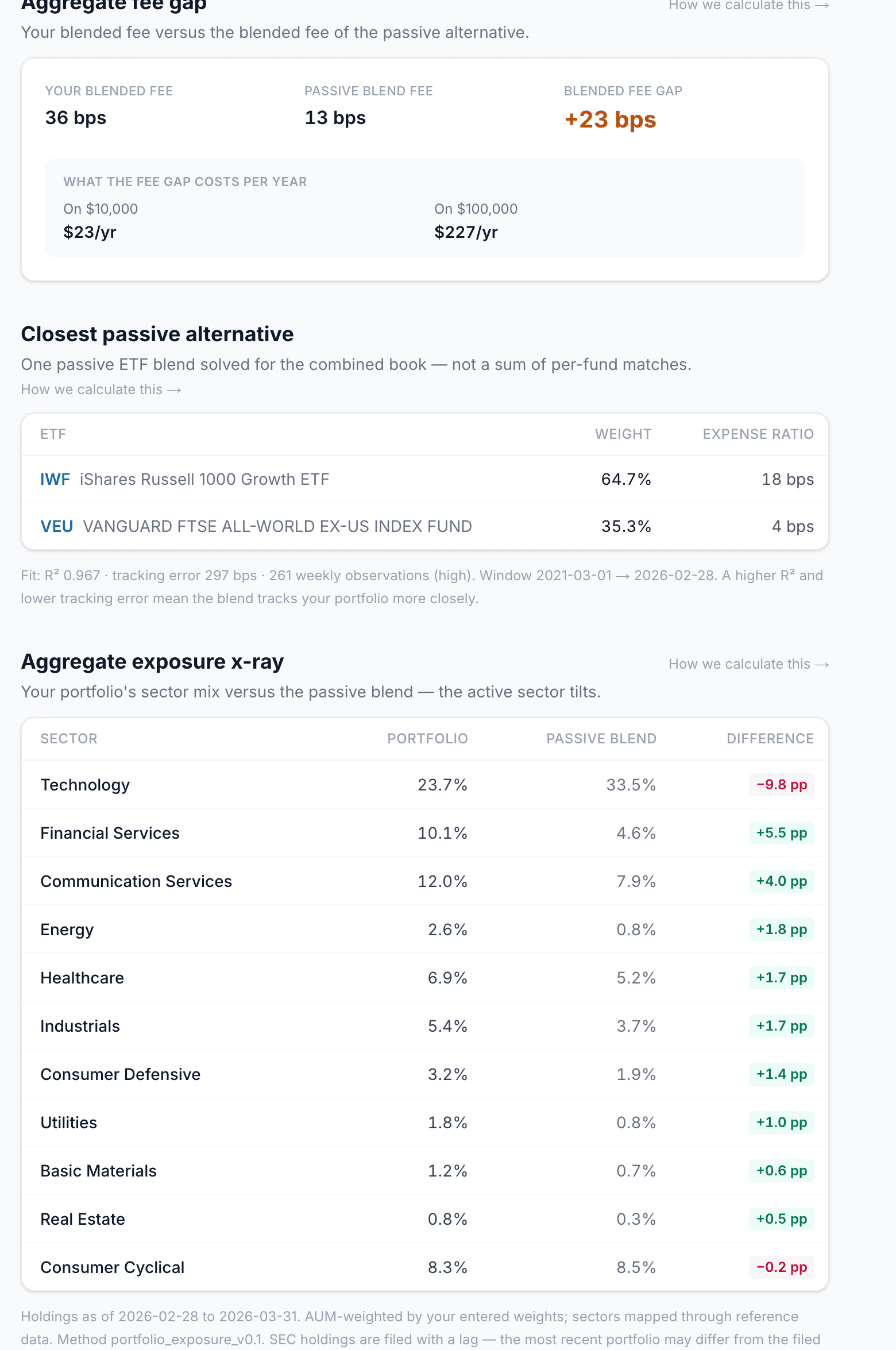
Here is a real three-fund portfolio: an S&P 500 index fund, an active growth fund, and an international fund. On paper, diversified.
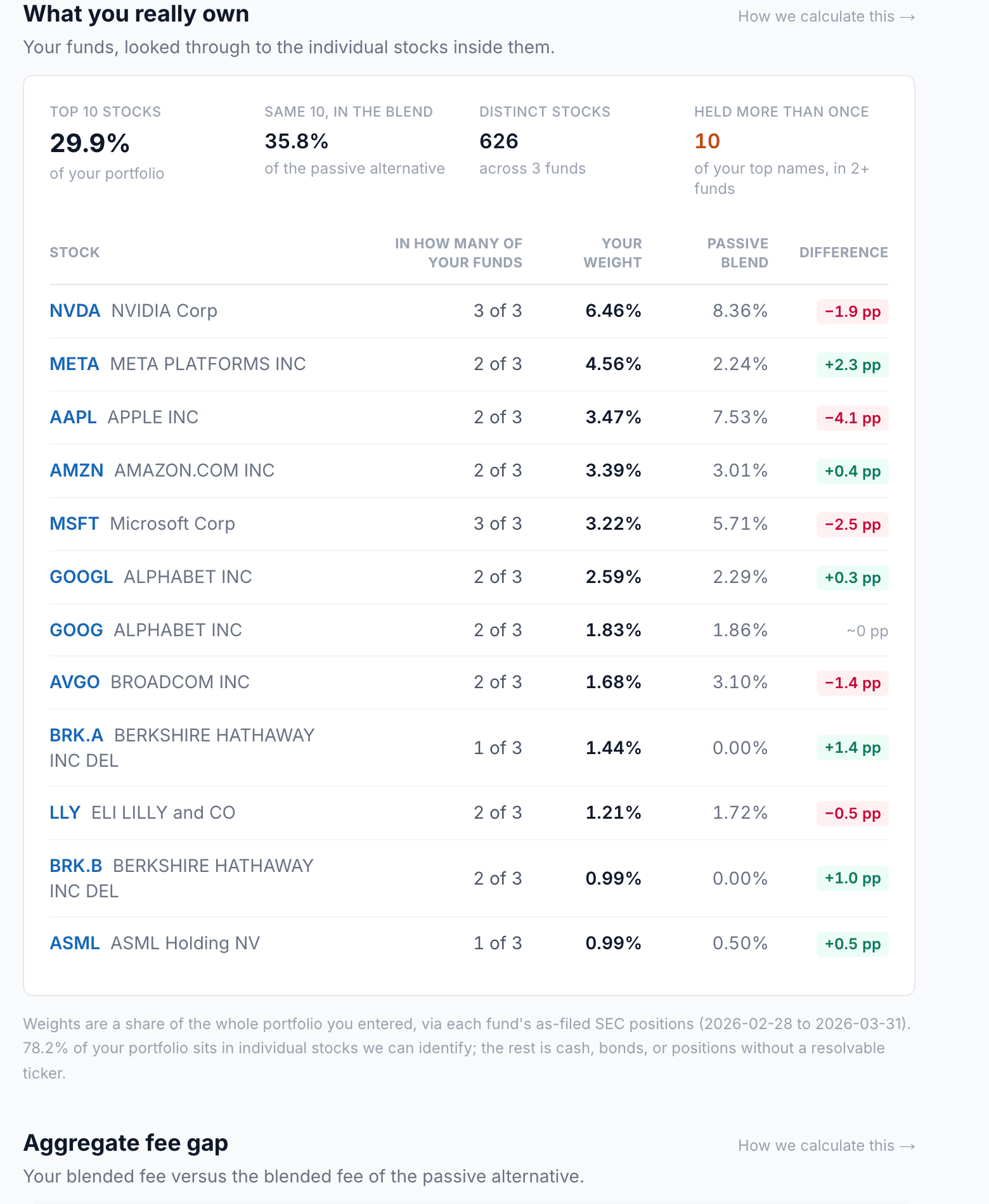
FundScore shows that all three of the funds hold Nvidia, that it is 6.46% of everything you own, that your top ten names are 29.9% of the book — and that you are paying 36 basis points for a portfolio the index would have handed you for 13. That gap is $227 a year on $100,000.
Knowing the category is not the same as understanding the bet.
What do I really own?
See what you really own.
FundScore builds your Best Passive Alternative — the low-cost ETF portfolio that most closely replicates what you already hold. Then it shows the active bets, fees, and manager value layered on top, mapping your portfolio across 169 exposure dimensions — companies and industries, investment themes (Magnificent 7, AI Infrastructure, Cloud Hyperscalers and more), style and factor tilts, and macro sensitivity to rates, credit, the dollar, gold, oil and broad commodities.
- Where you are unintentionally concentrated
- Whether your active funds diversify — or quietly cancel each other out
- Which stocks, sectors, macro factors and themes are driving your returns
- How much you pay above the passive alternative you could buy yourself
Fund names and categories can create the appearance of diversification while hiding the same underlying bets. The S&P 500 keeps 34.8% of its value in seven companies, and the median US large-cap active fund holds 20% in the same names.
MSFT · AMZN · META · NVDA · GOOGL · AVGO · AAPLThe seven most widely held stocks across every active equity fund we cover. Not one non-tech name until you reach Visa.
Did the manager earn it?
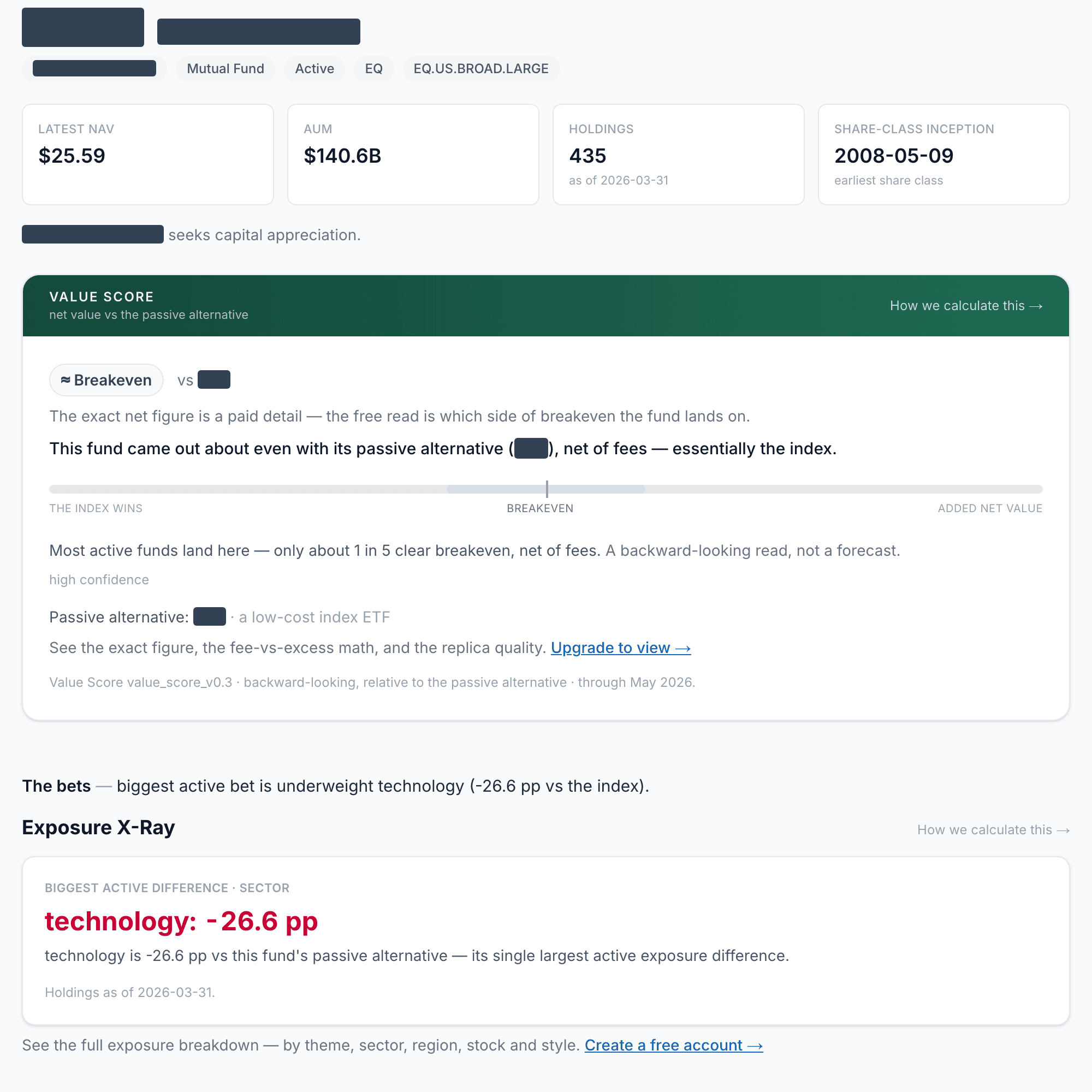
See what active management actually delivered.
A fund can outperform because its manager selected exceptional investments. It can also outperform because a sector, factor, or macro bet happened to work.
FundScore separates performance into:
- Broad market returns
- Systematic sector, style, theme and macro effects
- Security-selection value
- Fees
Are you paying for real skill — or expensive access to a trend you could get for less?
Find what you meant to buy
Search by the bet, not the label.
Most fund screeners start with categories, ratings, fees and past returns. FundScore starts with the exposure you want.
- Large-cap funds with less exposure to the AI trade
- Funds positioned for falling real rates
- ETFs and mutual funds exposed to reshoring
- Active managers with broad-based security-selection value
- Funds that diversify your current holdings instead of duplicating them
Across ETFs and open-end mutual funds, using the criteria you choose.
You bring the investment idea. FundScore provides the receipts.
Know when it changes
Know when the investment changes.
A fund can keep the same name while quietly becoming a very different investment — new sector bets, drifting factor tilts, a fresh manager reshaping the book.
FundScore tracks changes in a fund's positioning and tells you when it drifts from the role you hired it to play — so you learn it from the filings, not from the next statement.
Where the numbers come from
Built from the ground up on hard data.
FundScore analyses the actual holdings inside every fund, sourced directly from SEC filings — not fund names, marketing language, category labels, or vague reputations. Every exposure traces back to the securities underneath it. Every assessment shows the components behind the number.
We charge users, not fund companies. No paid placements. No affiliate-incentive ranking. The scores you see are not for sale.
Wrong data is worse than no data.
When something is missing, stale, or unsupported, we say so and suppress the claim rather than fill the hole. A fund with no fair passive stand-in does not get a number it hasn't earned.
Where we stand
Institutional questions. Built for individual investors.
Professional investors use holdings analysis, factor models and performance attribution to understand what is really inside a portfolio. FundScore brings those tools into one clear research experience.
No enterprise terminal.
No black-box recommendations.
No brokerage connection required.
- Active funds covered
- 4,004Active funds covered
- Exposure dimensions
- 169Exposure dimensions
- As-filed SEC positions
- 1.4 millionAs-filed SEC positions
- Fund series ingested
- 26,155Fund series ingested
Different funds don't always mean different bets.
See what's driving your portfolio, what you're paying for, and whether your active managers delivered something genuinely different. Your portfolio may be diversified. Or it may be the same trade in seven different wrappers.
FundScore is opening in stages. Leave your email and we'll let you in.
One email when we open. No newsletter, no sharing your address.
No brokerage login required. No trading access.